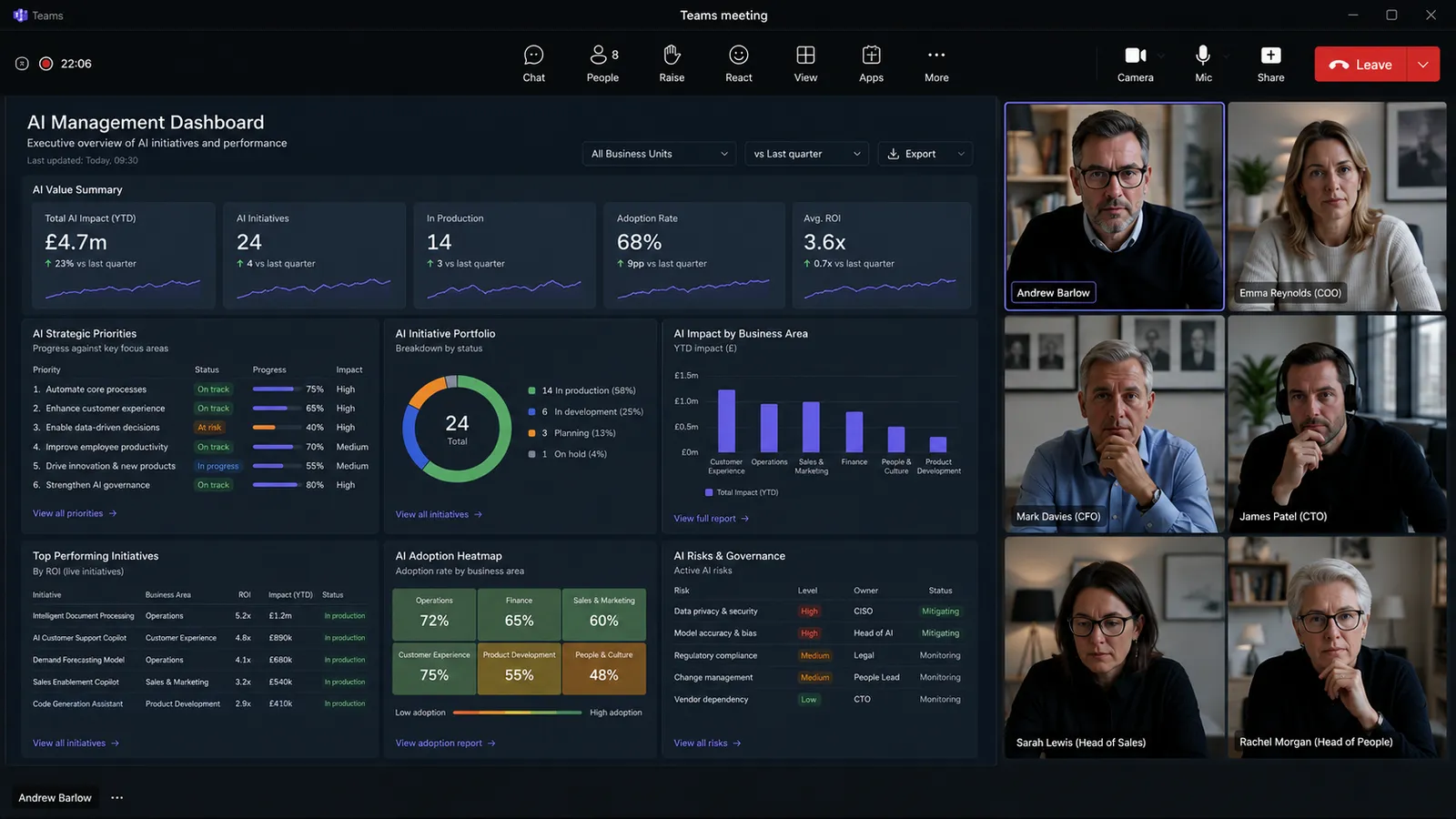
Something strange happened to AI in 2025.
The technology became more extraordinary.
The questions businesses need to answer about it became more ordinary.
Models learned to reason for longer. AI systems became better at writing software. Agents started using tools and taking actions. Claude could work across codebases. ChatGPT could move between reasoning, research and action. Frontier models became more capable while the cost of comparable levels of intelligence continued to fall.
Yet for a business leader, the questions increasingly sound like this:
Where should we invest? What should we prioritise? Which processes should change? Who owns the outcome? What information does the system need? Where should people remain involved? What risks are acceptable? How do we know whether it worked? What should we do next?
Those aren’t principally AI questions.
They’re management questions created by AI.
And I think that distinction tells us something important about where the technology is heading inside organisations.
AI is beginning to move beyond something businesses experiment with, buy or deploy.
It is becoming something they have to learn to manage.
The technology keeps making the question harder#
It would be easier if AI had stopped improving.
Businesses could assess the capability, decide where it was useful, implement a few systems and move on.
Instead, the opportunity keeps changing.
OpenAI released GPT-5 in August, combining fast responses with deeper reasoning and stronger capabilities in areas including coding and agentic tool use.
Anthropic released Claude Sonnet 4.5 in September, pushing further into coding, computer use and complex agents.
Across the frontier, models are becoming better at reasoning through difficult problems, working with tools, using context and completing longer sequences of work.
Meanwhile, the economics are changing too.
Stanford’s 2025 AI Index found that the cost of querying a model performing around GPT-3.5’s level on the MMLU benchmark fell more than 280-fold between November 2022 and October 2024.
So businesses aren’t dealing with a static technology.
They’re dealing with a moving capability frontier.
Something that wasn’t possible 12 months ago may be possible now. Something that isn’t reliable enough today may become reliable enough next year. Something that’s currently too expensive to justify may become economically obvious as costs fall.
And every expansion of capability creates another set of possible applications.
This produces a paradox.
The more AI can do, the less useful “Can AI do this?” becomes as a decision-making question.
Increasingly, the answer will be yes.
The more important questions become:
Should we do it?
Why?
What would improve?
Is it worth it?
More AI isn’t the objective#
This sounds obvious, but I think it’s worth stating explicitly.
The objective of an AI strategy shouldn’t be to maximise the amount of AI used by the organisation.
A company isn’t necessarily becoming better at AI because it has bought more licences, launched more pilots, built more agents, generated more prompts, automated more processes or trained more employees to use ChatGPT.
Those things may all contribute to value.
None of them is the value itself.
A mature organisation might actually choose not to use AI in many situations.
Perhaps the economics don’t work. Perhaps the existing process is already efficient. Perhaps the error tolerance is too low. Perhaps the required information isn’t available. Perhaps customer trust would be damaged. Perhaps implementation complexity outweighs the potential benefit.
Perhaps conventional software solves the problem perfectly well.
Or perhaps the problem simply isn’t important enough.
Saying no isn’t evidence of low AI maturity.
Sometimes it’s evidence of high AI maturity.
The world doesn’t need more indiscriminate AI adoption. It needs better decisions about where AI should be applied.
That distinction becomes increasingly important as AI gets easier to use.
Scarcity used to perform some of the prioritisation#
There is an economic reason this problem is getting harder.
When a technology is expensive, difficult and specialist, scarcity performs some of the prioritisation for you.
Only the most obvious applications justify the investment.
But AI capability is becoming increasingly accessible.
Employees can experiment themselves. Departments can buy AI-enabled software. Developers can access frontier models through APIs. Agents make it possible to contemplate automating or delegating larger pieces of work.
And the cost of useful machine intelligence continues to fall.
The result is an explosion of possibilities.
Earlier this year I wrote that businesses can’t pursue every AI opportunity.
I think that becomes more important, not less, as the technology improves.
A company may eventually identify hundreds or thousands of things AI could help with.
It still has finite capital.
Finite leadership attention.
Finite implementation capacity.
Finite tolerance for organisational change.
Finite employee time.
And finite ability to absorb new technology.
AI makes possibility abundant.
It doesn’t make organisational capacity infinite.
That means opportunity discovery has to be accompanied by opportunity selection.
And selection is a management problem.
The AI opportunity is an economic question#
This is why I’ve become increasingly sceptical of starting with lists of AI use cases.
They’re useful for inspiration.
But they’re a poor substitute for understanding the business.
The same AI application can be enormously valuable in one organisation and almost irrelevant in another.
The difference may have nothing to do with the technology.
It may depend on volume, cost, margin, frequency, customer behaviour, process design, available data, existing systems, employee capability, strategic priorities or the economic consequence of getting something slightly better.
The useful starting point isn’t:
Where can we use AI?
It’s:
Where does this business create, lose or constrain value — and has AI changed what is possible there?
That shifts the conversation away from technology adoption and towards economic leverage.
As I argued in The Best AI Opportunities Start With Economics, the value of an AI opportunity depends on the economics of the business around it, not simply the capability of the model.
And it changes what good AI leadership looks like.
The job isn’t to find the maximum number of places where AI fits.
It’s to identify the relatively small number of places where applying it could materially improve something the organisation cares about.
Finding the opportunity is only the beginning#
Even choosing the right opportunity doesn’t guarantee value.
That has probably been one of the clearest lessons of 2025.
McKinsey’s March State of AI research found widespread use of generative AI, but most respondents still reported no tangible organisation-wide EBIT impact.
The research also found that redesigning workflows had the strongest relationship with self-reported EBIT impact among the 25 organisational attributes it examined.
Only 21% of respondents whose organisations used generative AI said their organisations had fundamentally redesigned at least some workflows.
That gap matters.
Because AI capability and organisational capability aren’t the same thing.
A model might be capable of doing something useful.
But value still depends on whether the organisation can integrate that capability into how work actually happens.
That may require changing a workflow. Connecting systems. Providing the right context. Cleaning up information. Redefining responsibilities. Establishing permissions. Changing measures. Training employees. Redesigning customer interactions.
Or removing steps that only existed because the old technology couldn’t do something the new technology can.
A demonstration proves that something is possible.
Implementation determines whether it becomes useful.
Better models don’t know your business#
There is another constraint that improving frontier models don’t automatically solve.
They don’t know everything your organisation knows.
They may possess extraordinary general knowledge. They can reason, research, analyse, write, code, use tools and, increasingly, act.
But they don’t automatically understand your customers.
Your economics.
Your previous decisions.
Your operating constraints.
Your internal definitions.
Your exceptions.
Your relationships.
Your risk appetite.
Your proprietary knowledge.
Your history.
Or the tacit knowledge held by people who have worked inside the business for years.
As general AI capability becomes more widely available, this organisational context may become increasingly important.
Your competitors can access many of the same models.
They can’t automatically access everything your organisation knows.
That means part of managing AI is managing the relationship between general intelligence and specific context.
As I wrote in Your AI Doesn’t Know Your Business, the quality of the model is only one part of the system; the information and context available to it can determine how useful that intelligence becomes.
The better the intelligence becomes, the more consequential that context can become.
Especially when AI starts doing rather than merely answering.
Work has to change somewhere#
AI also creates an uncomfortable organisational reality.
Value rarely appears simply because software has been installed.
Something usually has to change.
A person works differently. A process becomes shorter. A decision becomes better. A customer gets a faster response. An employee handles more work. A manager gets better information. A task disappears. A workflow is redesigned. A new capability becomes possible.
This is why adoption matters.
But adoption isn’t the same thing as value either.
An organisation can have thousands of employees enthusiastically using AI without materially improving its economics.
People can generate better emails while the underlying sales process remains unchanged.
They can produce documents faster while the organisation simply produces more documents.
They can save time without the business doing anything useful with the capacity released.
Technology creates capability.
People turn capability into organisational value.
And management has to connect the two.
Someone has to own the outcome#
The cross-functional nature of AI makes this difficult.
IT may own the technology. Operations owns the process. Finance understands the economics. HR deals with workforce implications. Legal and Compliance understand certain risks. Data teams manage information. Employees discover opportunities. The CEO owns strategic priorities. External partners may implement parts of the solution.
Everyone can own a piece.
Which creates the possibility that nobody owns whether AI actually creates value.
That isn’t solved simply by appointing a Chief AI Officer.
For some organisations, a dedicated AI leadership role will make sense.
For others, responsibility may sit with an existing executive.
The title matters less than the accountability.
Somebody needs to connect opportunity, investment, implementation, people and outcome.
Not to centralise every AI decision.
But to ensure distributed decisions add up to something.
This is why at some point, someone has to own AI — not merely the technology, but whether the organisation turns it into an outcome.
Owning AI technology isn’t the same as owning AI outcomes.
What gets measured becomes important#
Ownership eventually leads to an uncomfortable question.
Did it work?
This is where AI programmes can become confused.
Usage is easy to measure.
Licences activated. Weekly active users. Prompts submitted. Agents executed. Documents generated. Employees trained.
Those numbers tell us something.
They don’t necessarily tell us whether the organisation became better.
If AI was introduced to increase sales conversion, conversion matters.
If it was introduced to reduce errors, errors matter.
If it was introduced to release operational capacity, capacity matters.
If it was introduced to reduce cost, cost matters.
If it was introduced to improve customer retention, retention matters.
If it was introduced to speed up a process, cycle time matters.
McKinsey’s 2025 research found that tracking well-defined KPIs for generative-AI solutions was the adoption and scaling practice most associated with self-reported bottom-line impact among the practices it tested.
Again, correlation isn’t causation.
But the underlying principle is useful.
Using AI is not the outcome.
The outcome is whatever the AI was supposed to make better.
AI maturity may eventually look surprisingly boring#
This leads to an interesting possibility.
Perhaps mature AI organisations won’t look particularly obsessed with AI.
Today, AI attracts dedicated strategies, AI committees, AI working groups, AI transformation programmes, AI roadmaps, AI budgets and AI leadership roles.
That makes sense.
The technology is novel, fast-moving and potentially consequential enough to require concentrated attention.
But successful technologies have a habit of disappearing into normal business.
Companies don’t usually begin every software decision by asking how they should use the internet.
They don’t treat every cloud-based application as part of a separate cloud transformation programme.
Digital technology became embedded into how organisations operate.
AI may eventually do the same.
Sales software will contain intelligence.
Finance software will contain intelligence.
Customer-service systems will contain intelligence.
Managers will routinely use AI to analyse problems.
Employees will work with agents.
Software development will incorporate AI by default.
Operational systems will make intelligent decisions.
At some point, separating “AI” from “the business” may become increasingly artificial.
And when that happens, AI maturity won’t mean talking about AI more.
It may mean needing to talk about it less.
The durable capability is learning how to decide#
This is why I don’t think the most valuable AI strategy is a document explaining what a company should implement today.
Today’s recommendations have a short shelf life.
Models will change.
Costs will fall.
Agents will improve.
Regulation will evolve.
Employees will become more capable.
Software products will absorb new AI features.
New opportunities will emerge.
Some current limitations will disappear.
New limitations will appear.
The durable capability is something different.
It’s becoming good at repeatedly understanding what has changed.
Finding where new capabilities intersect with valuable business problems.
Evaluating those opportunities economically.
Choosing what matters.
As intelligence becomes cheaper and more abundant, the scarcity increasingly moves towards selection and judgement.
Implementing carefully.
Connecting AI to the organisation’s context.
Redesigning work when necessary.
Helping people adapt.
Managing risk.
Measuring what actually changed.
Learning from the result.
And then doing it again.
The durable AI capability isn’t knowing what to implement today. It’s becoming good at deciding what to do as the technology changes.
That is why I increasingly think AI is becoming a management discipline.
Not because every manager needs to become an AI expert.
They don’t.
But managers increasingly need to understand enough about AI to make good decisions in a world where artificial intelligence is becoming another source of organisational capability.
Eventually, AI strategy disappears#
For now, AI deserves concentrated attention.
The technology is moving too quickly and the implications are too significant to treat it as business as usual.
But business as usual is ultimately where transformative technologies go.
The organisations that benefit most from AI may not be those that use the most AI.
They may be the organisations that become best at recognising when it matters.
Applying it precisely.
Changing what needs to change.
Giving it the context it needs.
Involving people intelligently.
Managing the risks.
And measuring whether anything valuable actually happened.
That requires technical understanding.
But increasingly, it also requires something much older.
Good management.
And perhaps that’s where this ultimately leads.
The most successful businesses won’t have AI sitting alongside their strategy.
AI will simply become one of the capabilities available to execute it.
They won’t begin with AI and search for somewhere to apply it.
They’ll begin with the business and understand when AI changes what is possible.
They won’t measure success by how much AI they use.
They’ll measure what the business achieves because of it.
AI strategy matters enormously today.
But if this technology becomes as embedded in organisations as I suspect it will, its ultimate destination may be to disappear into everything else.
The end state of AI strategy may be that we stop calling it AI strategy at all.