A $122 billion funding round is difficult to process as a normal technology story. On 31 March, OpenAI said it had closed $122 billion in committed capital at a post-money valuation of $852 billion.
The headline numbers are extraordinary. But the sentence that interested me more was OpenAI’s description of what it believes it is becoming: core infrastructure for AI. It fits the way I have started to think about AI.
We still tend to talk about artificial intelligence as a category of software. Models, apps, copilots, subscriptions. The capital being assembled around it suggests something larger. If these investments make economic sense, the bet is not simply that people will buy more software. It is that machine intelligence becomes an input used throughout the economy.
Follow the capital
I do not think AI itself is a bubble. I am using different models to build things and get work done, so the usefulness is fairly tangible to me. That does not mean every company is worth its valuation, every investment will pay back or every data centre will be needed in the form originally planned. A useful technology can still attract too much money in the wrong places.
Capital does not prove a thesis. Technology markets have a long history of overinvestment, speculative enthusiasm and very expensive mistakes. So I would not look at OpenAI’s valuation and conclude that a particular future is inevitable. I would ask what future investors and infrastructure providers appear to be underwriting.
Training and serving frontier models requires enormous quantities of compute, power, networking, data-centre capacity and specialist hardware. OpenAI’s March announcement explicitly linked durable compute access to research progress, product improvement, broader access and lower delivery costs. That is the language of an infrastructure system.
The interesting comparison is not that AI is literally electricity. It is that electricity became valuable because thousands of other activities could be reorganised around reliable access to it. The same question now hangs over intelligence. What happens when useful cognitive capability becomes available on demand, through software, at enormous scale?
Intelligence becomes an input
Businesses already buy intelligence. They hire analysts, developers, lawyers, marketers, accountants, researchers, consultants and managers. They pay people to interpret information, produce artefacts, make decisions and coordinate work. AI does not replace all of that. But it changes the supply curve for parts of it.
A task that once required scarce specialist time may become partially automated. Analysis that was too expensive to perform on every case may become economical. Software that was not worth building may become cheap enough to create. A small team may attempt work previously requiring a much larger one.
That is why I think “AI software” is an increasingly narrow description. The important economic question is what becomes possible when intelligence itself becomes cheaper, faster and more abundant.
The biggest AI story may eventually be less about the models themselves and more about what the rest of the economy rebuilds around cheap intelligence.
Infrastructure disappears into everything
Good infrastructure becomes boring. Nobody describes a modern company as an “electricity-enabled business”. Almost every business depends on electricity. We do not marvel that a retailer uses cloud computing every time a customer checks out online. Infrastructure matters precisely because it disappears beneath other activity.
AI could follow a similar path. Today, organisations create explicit AI initiatives because the capability is new and organisationally unusual. Over time, the label may become less useful.
Customer service software will contain intelligence. Finance systems will contain intelligence. Development environments will contain intelligence. Manufacturing, logistics, healthcare, media and professional services will embed different forms of intelligence directly into workflows.
At that point, asking whether a business “uses AI” may become as strange as asking whether it uses databases. The better question will be how effectively the business exploits the capability.
The physical constraint is real
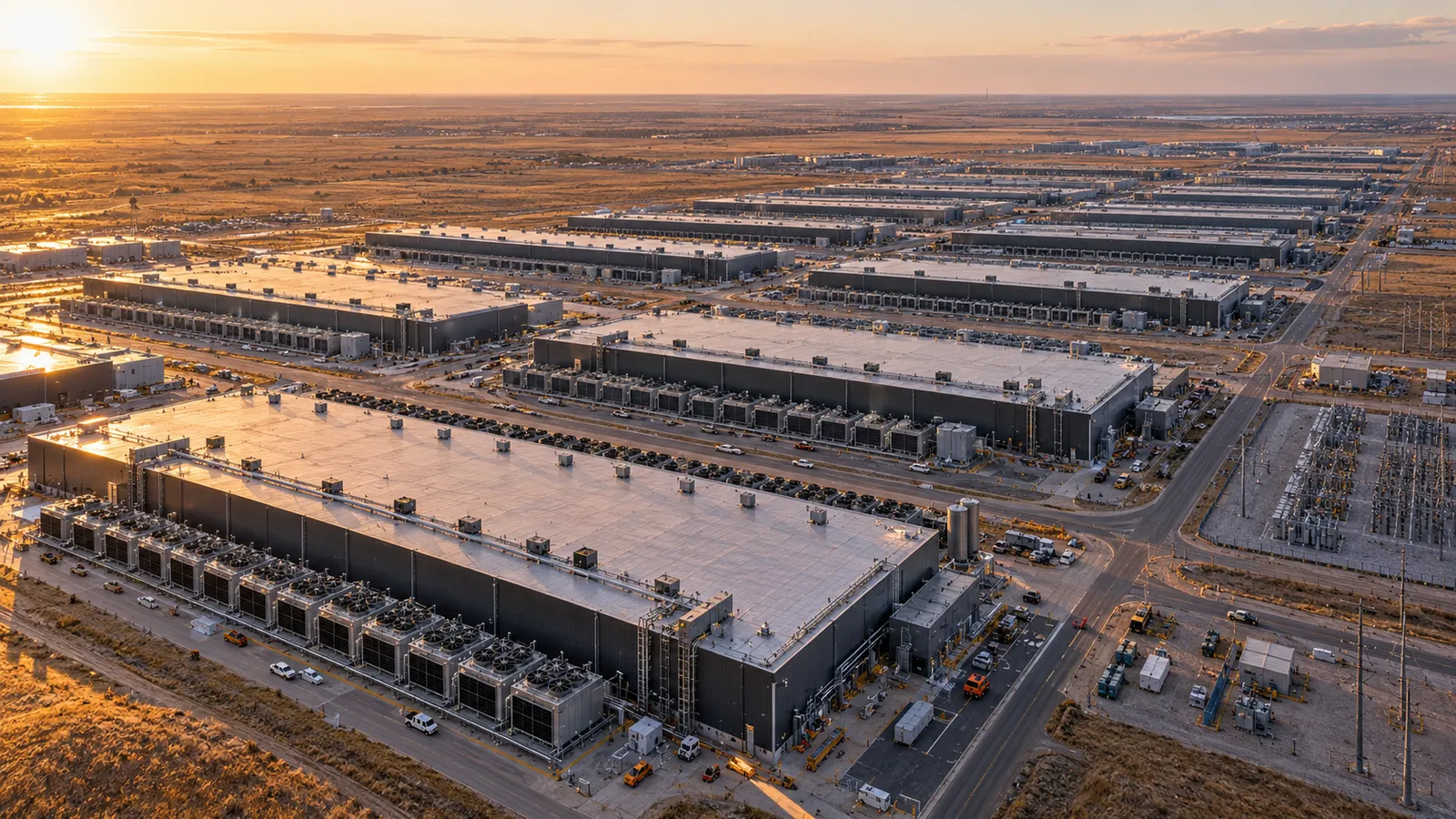
There is a useful contradiction here. AI feels weightless. You type into a box and an answer appears. Behind that interaction sits one of the largest physical infrastructure build-outs in technology.
Data centres have to be built. Chips have to be manufactured. Electricity has to be generated and transmitted. Networks have to move data. Cooling systems have to remove heat. That physical reality matters because abundance at the software layer depends on scarcity being solved elsewhere.
OpenAI’s announcement emphasised compute as a strategic advantage. Its February partnership with Amazon included plans for OpenAI to consume two gigawatts of Trainium capacity. Those numbers pull AI strategy into energy, industrial policy, semiconductors and capital markets. The future of software is becoming surprisingly physical.
What this means for businesses
Most companies do not need an infrastructure strategy for frontier-model training. They do need to think about what happens downstream. If capability keeps improving while the unit cost of useful intelligence falls, assumptions embedded in today’s operating model can become stale.
- How much analysis is economical?
- How much software is economical to build?
- How personalised can a service become?
- How many decisions can receive specialist support?
- Which queues exist only because expert attention is scarce?
- Which processes were designed around the cost of human cognition?
Those are more interesting questions than whether the company has purchased an AI licence. Infrastructure changes markets when businesses discover new things to build on top of it.
There will be waste
It is worth resisting the temptation to turn this into a straight-line forecast. Infrastructure booms create excess. Not every data centre will earn its expected return. Not every model company will survive. Not every AI application deserves to exist. Some capital will be destroyed.
That does not necessarily invalidate the underlying transition. The dot-com era produced spectacular failures while still financing infrastructure and companies that reshaped the economy. The important distinction is between predicting individual winners and recognising a structural shift. I am much more confident in the latter than the former.
Capacity is a bet on what comes next
I am wary of treating spare capacity as proof that the whole investment has failed. Infrastructure needs some headroom if people are going to build on it. Equally, calling something infrastructure does not make the economics work. Someone still needs to use it and pay enough to justify what was built.
Efficiency makes that judgement harder. Better chips and models could reduce the compute needed for a particular task. They could also make more tasks worth doing. I would not assume either that demand grows forever or that improving efficiency makes new capacity unnecessary. Both sides can move.
There is also a difference between using AI because it is built into something and actively deciding what to do with it. More people may become users without thinking much about it. I suspect the larger advantage will sit with people and businesses that learn to direct that capability towards something worthwhile.
Think one layer higher
OpenAI’s $122 billion raise will naturally generate debate about valuation. I think the more useful exercise for a business leader is to step one layer higher.
Assume, without assuming perfection, that increasingly capable machine intelligence becomes cheaper and more available over the next several years. Then ask what your business would look like if that were true.
- Which costs change?
- Which constraints weaken?
- Which customer experiences become possible?
- Which competitors can be created with much smaller teams?
- Which parts of your existing advantage become less scarce?
- And which proprietary assets become more valuable when combined with abundant intelligence?
Those questions do not require believing every AI forecast. They require noticing the direction of travel.
OpenAI may or may not justify an $852 billion valuation. But the amount of capital now being committed tells us something important about the scale of the bet.
We should probably stop thinking about AI as another application category. The more consequential possibility is that it becomes part of what everything else runs on.
Source: OpenAI — $122bn funding round