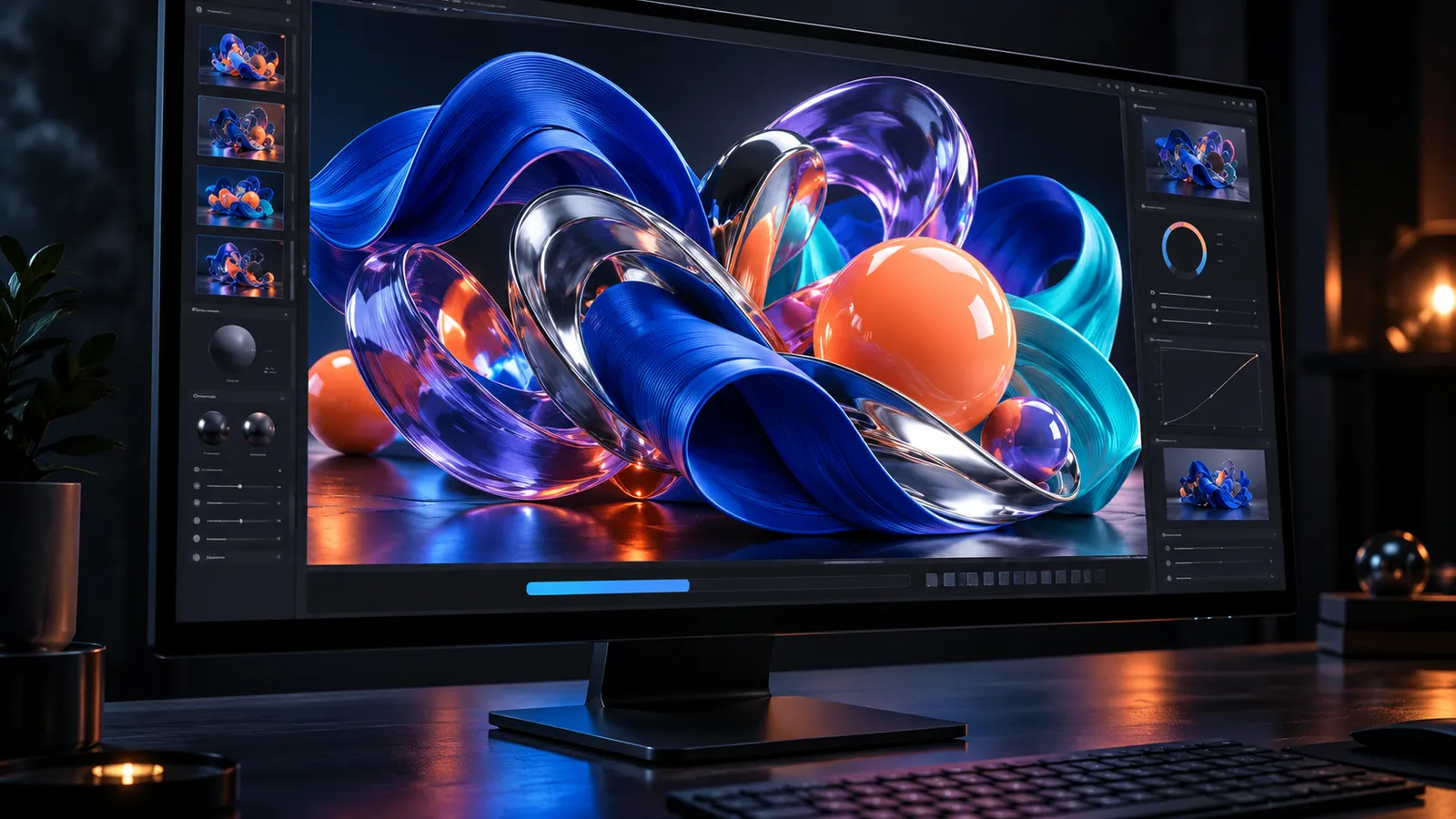
What struck me about Astra was not one benchmark or a single impressive answer. Several things I use AI for began to feel more useful together: holding the context of a conversation, presenting information clearly, working with images and helping me develop products.
I am a visual person. I often understand an idea better once I can see something, respond to it and work through what needs to change. That makes the quality of visual generation and the way information is presented particularly important to me.
The difference is in how I am using the system. It is becoming part of the work I do, rather than just somewhere I go to ask a question.
Intelligence is becoming operational
I now use these capabilities inside technologies I am building. Image selection, interpretation and generation can become parts of an application workflow instead of separate requests in a chat.
That is more useful when the model has a clear brief and its output goes through a quality-assurance stage. I have been building those processes around the capabilities because a good individual output is only one part of a dependable result.
The model matters, but so does the system around it. I need to define what I am asking for, what a good result looks like and how I will decide whether it meets the brief.
Benchmarks are not the experience
One improvement I have noticed is how long useful context seems to remain available. Work often develops over an extended conversation. When the system loses the thread, I have to stop and reconstruct the problem before we can continue.
Less of that repeated briefing makes a real difference to me. I can spend more time developing the idea and less time explaining the same background.
I am judging the interaction here: whether I have to explain myself again and whether the next result reflects the work we have already done.
The cost of supervision matters
I used to find AI-generated UI concepts frustrating. An output might show one narrow example, arrive in the wrong aspect ratio or fail to keep the colours and shapes of the product I was discussing.
A visually impressive result could still be difficult to use. If I had to keep correcting the same constraints, much of the apparent speed disappeared in supervision.
I now find the outputs more useful for exploring interfaces and user experiences. I can inspect a direction, identify what is wrong and develop it. The test is whether that helps me make a better product decision, rather than how impressive the image looks in isolation.
More access needs clearer boundaries
More useful computer-based capability also makes control important. A system connected to the tools where work happens needs boundaries around what it can access and change.
I would not take a good experience in design or prototyping as evidence that the same system should be allowed to act freely in a more consequential setting. Permissions, verification and accountability need to reflect the work being delegated.
That remains true as capability improves. Being able to ask for a more ambitious outcome makes it more important to understand the consequences of getting it wrong.
Visual work is becoming more practical
Visual generation has become more relevant to product development for me. In the past, discussing a feature often meant creating mock-ups to explain how it might look, how someone would use it and why it would help.
I can now explore more of that directly with AI. It gives me something I can respond to before committing more effort to a particular direction.
I am not looking for a recognisable AI aesthetic. I want images and concepts that preserve realism, fit the visual context and help me do the work. Novelty is much less valuable than something I can actually use.
The interface may be intent
The closest analogy I have is a strong design lead in my pocket. It gives me someone to work through a visual direction with, while I still make the decisions about what is right for the product.
There is a difference between asking for an image with a few objects in it and getting help with composition, presentation and how someone might interpret the result. I increasingly feel I can have the second kind of interaction.
It still needs direction. I have to explain the context and make decisions about the output. But the conversation can operate at the level of what I am trying to achieve, rather than only specifying every visual element.
Better AI can expose worse organisations
The same issue applies inside a business. A system cannot reliably follow an objective that nobody has defined clearly or resolve contradictory instructions simply by becoming more capable.
My own experience with briefs and QA reinforces that. The result improves when I put thought into the request and the checks around it. A more capable model gives me more to work with, but it does not remove my part of the job.
For an organisation, that means understanding the workflow, the relevant information and who accepts responsibility for the result. Access to the model is only the beginning.
Judge what becomes useful
I find the practical changes more useful to think about than arguments over labels. Can I explore a product idea more effectively? Does the system retain enough context to help me progress it? Can I use its output inside something I am building?
The presentation of information matters too. A long answer or a rudimentary text diagram can be hard to interpret, even when the underlying reasoning is useful. Representing that information in a form I can understand and respond to improves the interaction.
For me, that is part of usability. An answer has limited practical value if I cannot efficiently work out what to do with it.
The question after Astra
I do not know exactly how these systems arrive at a composition or why one output works better than another. I can judge what comes back and how it affects my work.
What feels different is the combination: context, visual generation, clearer representation and integration into products. Together, those capabilities let me use AI in ways that were previously much less practical.
That is what I would look for when evaluating the next model too. I want to know what I can now do with it, how much correction it needs and whether the result is useful enough to become part of a real workflow.
Sources: OpenAI — GPT-6 Astra · Path to Astra